
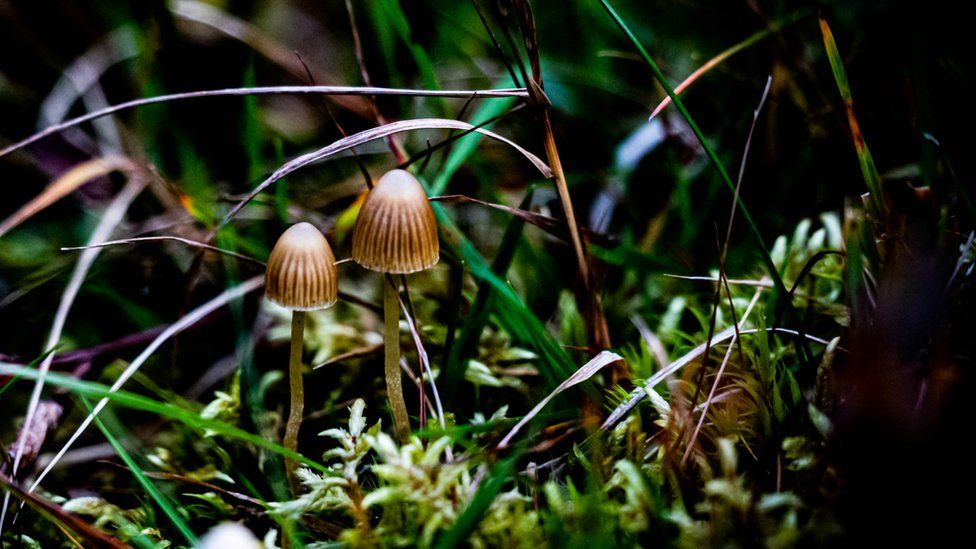
Psychedelic drug psilocybin, found in magic mushrooms, is as good at reducing symptoms of depression as conventional treatment, a small, early-stage study has suggested.
But when it comes to actively improve people's well-being and ability to feel pleasure, the psychedelic drug may have had a more powerful effect.
Psychedelics are being studied for a range of mental health conditions.
But experts caution that this is a small trial with more research needed.
For the past three decades, since Prozac hit the market, new drugs for depression and anxiety have generally been variations on the same theme.
Yet for a considerable chunk of people, they cause undesirable side-effects, stop working overtime or don't work in the first place.
The psilocybin trial's leaders said there was an appetite for "novel" treatments that took a different approach.
The trial's 59 participants were given either psilocybin or a common antidepressant called a selective serotonin reuptake inhibitor (SSRI).
The scientists from Imperial College London's Centre for Psychedelic Research measured participants' mood and functioning using a number of different measures.
Their primary measure scores people's symptoms of depression based on their answers to questions about sleep, energy, appetite, mood and suicidal thoughts.
These questions are largely negatively focused: they ask whether someone is feeling sad, but not whether they are feeling happy.
By this measure, psilocybin performed as well as a conventional antidepressant - an SSRI called escitalopram.
All 59 participants saw comparable reductions in their depressive symptoms.
But on several other measures - though they weren't the scientists' primary focus - the psychedelic drug performed considerably better.
That includes measures of work and social functioning, mental well-being and the ability to feel happy.
The study is among the first to pit the psychedelic head-to-head with a traditional depression treatment - and to open the trial to anyone with moderate-to-severe depression, not just those for whom all other treatments had failed.
'No quantum leap'
As well as being a small trial, though, this represents a relatively early phase in the research, so more studies will be needed to prove this effect.
And the study is "not a quantum leap", according to Guy Goodwin, professor of psychiatry at the University of Oxford.
"It is underpowered and does not prove that psilocybin is a better treatment than standard treatment with escitalopram for major depression.
"However, it offers tantalising clues that it may be".
It adds to the growing body of research suggesting psychedelics could be a viable alternative treatment for depression, anxiety, substance misuse and other common conditions.
And, Prof Goodwin added, the work "underlines the broader point that research in depression has been too driven by ratings of particular symptoms rather than the return of positive mood and patient well-being".
SSRIs like fluoxetine (the generic name for Prozac), citalopram, escitalopram and sertraline are the drugs doctors will reach for first when treating depression and anxiety.
'Emotional blunting'
They are thought to work on the brain's stress system, muting responses, which can "take the edge off", study author Dr Robin Carhart-Harris explained, making painful emotions easier to bear.
But they don't necessarily help people "feel great," he said - and for some the drugs blunt all emotions, both positive and negative.
This emotional blunting can be an unwelcome side-effect.
On the other hand, psilocybin seems to work on receptors in the brain associated with "re-ordering" the way we think about things.
Dr Carhart-Harris said that after psychedelic therapy, participants reported feeling "recalibrated, reset like they haven't for years" and "enjoying life".
"They get more at the root cause of suffering [rather than] plastering over or muting their symptoms."
People in the psilocybin treatment group also experienced fewer of the side-effects that often bother people taking SSRIs: drowsiness, sexual dysfunction and dry mouth.
They did have more transient symptoms, such as headaches on the day after receiving the drug, though.
And the experience of the "trip" itself was not easy, the study's co-author Prof David Nutt explained. "This is hard, hard work. It's often very challenging."
Those being given psilocybin received two relatively high doses of the drug, three weeks apart, while people on the escitalopram arm of the study took that pill every day for six weeks.
Both groups were given therapy.
Prof Nutt said the therapy was "as important as the drug action" - the scientists are anxious to warn against people trying to self-medicate.
"It's not the drug alone. We're not sure the drug alone would have an intrinsic antidepressant effect," he said.
In order to try to "blind" people as to which group they were in - to prevent their expectations altering how they responded to the medication - those on the psychedelic arm were given a daily placebo pill and those on the SSRI arm had two guided sessions during which they were given 1mg of psilocybin (not enough to have a real effect).
For obvious reasons, it is quite challenging to "blind" people to whether or not they've received a large dose of psychedelics.
But Dr Carhart-Harris said other studies suggested people continued to feel better for months after psilocybin treatment, making it unlikely to be just the effect of positive expectations.
The participants in the Imperial study are being followed up for six months after their initial six-week treatment.
But when it comes to actively improve people's well-being and ability to feel pleasure, the psychedelic drug may have had a more powerful effect.
Psychedelics are being studied for a range of mental health conditions.
But experts caution that this is a small trial with more research needed.
For the past three decades, since Prozac hit the market, new drugs for depression and anxiety have generally been variations on the same theme.
Yet for a considerable chunk of people, they cause undesirable side-effects, stop working overtime or don't work in the first place.
The psilocybin trial's leaders said there was an appetite for "novel" treatments that took a different approach.
The trial's 59 participants were given either psilocybin or a common antidepressant called a selective serotonin reuptake inhibitor (SSRI).
The scientists from Imperial College London's Centre for Psychedelic Research measured participants' mood and functioning using a number of different measures.
Their primary measure scores people's symptoms of depression based on their answers to questions about sleep, energy, appetite, mood and suicidal thoughts.
These questions are largely negatively focused: they ask whether someone is feeling sad, but not whether they are feeling happy.
By this measure, psilocybin performed as well as a conventional antidepressant - an SSRI called escitalopram.
All 59 participants saw comparable reductions in their depressive symptoms.
But on several other measures - though they weren't the scientists' primary focus - the psychedelic drug performed considerably better.
That includes measures of work and social functioning, mental well-being and the ability to feel happy.
The study is among the first to pit the psychedelic head-to-head with a traditional depression treatment - and to open the trial to anyone with moderate-to-severe depression, not just those for whom all other treatments had failed.
'No quantum leap'
As well as being a small trial, though, this represents a relatively early phase in the research, so more studies will be needed to prove this effect.
And the study is "not a quantum leap", according to Guy Goodwin, professor of psychiatry at the University of Oxford.
"It is underpowered and does not prove that psilocybin is a better treatment than standard treatment with escitalopram for major depression.
"However, it offers tantalising clues that it may be".
It adds to the growing body of research suggesting psychedelics could be a viable alternative treatment for depression, anxiety, substance misuse and other common conditions.
And, Prof Goodwin added, the work "underlines the broader point that research in depression has been too driven by ratings of particular symptoms rather than the return of positive mood and patient well-being".
SSRIs like fluoxetine (the generic name for Prozac), citalopram, escitalopram and sertraline are the drugs doctors will reach for first when treating depression and anxiety.
'Emotional blunting'
They are thought to work on the brain's stress system, muting responses, which can "take the edge off", study author Dr Robin Carhart-Harris explained, making painful emotions easier to bear.
But they don't necessarily help people "feel great," he said - and for some the drugs blunt all emotions, both positive and negative.
This emotional blunting can be an unwelcome side-effect.
On the other hand, psilocybin seems to work on receptors in the brain associated with "re-ordering" the way we think about things.
Dr Carhart-Harris said that after psychedelic therapy, participants reported feeling "recalibrated, reset like they haven't for years" and "enjoying life".
"They get more at the root cause of suffering [rather than] plastering over or muting their symptoms."
People in the psilocybin treatment group also experienced fewer of the side-effects that often bother people taking SSRIs: drowsiness, sexual dysfunction and dry mouth.
They did have more transient symptoms, such as headaches on the day after receiving the drug, though.
And the experience of the "trip" itself was not easy, the study's co-author Prof David Nutt explained. "This is hard, hard work. It's often very challenging."
Those being given psilocybin received two relatively high doses of the drug, three weeks apart, while people on the escitalopram arm of the study took that pill every day for six weeks.
Both groups were given therapy.
Prof Nutt said the therapy was "as important as the drug action" - the scientists are anxious to warn against people trying to self-medicate.
"It's not the drug alone. We're not sure the drug alone would have an intrinsic antidepressant effect," he said.
In order to try to "blind" people as to which group they were in - to prevent their expectations altering how they responded to the medication - those on the psychedelic arm were given a daily placebo pill and those on the SSRI arm had two guided sessions during which they were given 1mg of psilocybin (not enough to have a real effect).
For obvious reasons, it is quite challenging to "blind" people to whether or not they've received a large dose of psychedelics.
But Dr Carhart-Harris said other studies suggested people continued to feel better for months after psilocybin treatment, making it unlikely to be just the effect of positive expectations.
The participants in the Imperial study are being followed up for six months after their initial six-week treatment.